Showing posts with label technology. Show all posts

Friday, November 18, 2011

National electronic health records network gets closer

National electronic health records network gets closer

 @CNNMoneyTech November 18, 2011: 5:39 AM ET
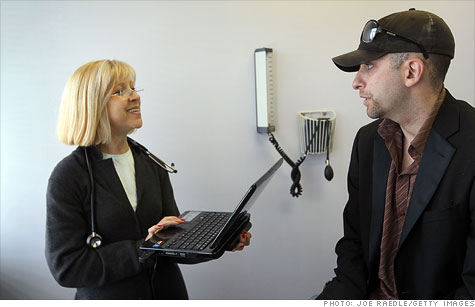
An electronic health records network is becoming a reality, as the national attitude towards health IT is shifting towards acceptance.
NEW YORK (CNNMoney) -- The ambitious goal of setting up a nationwide, interconnected, private and secure electronic health records system isn't yet a reality -- but we're getting closer.
The 2009 Recovery Act, better known as the stimulus bill, set aside more than $20 billion for incentives to health care providers that deploy and meaningfully use certified electronic health records systems in their offices or hospitals. The first incentives are set to go out in the form of $22,000 Medicaid payments to early adopters within the next six months.
The problem with the current system is clear: Paper trails get lost, incorrect prescriptions get written, and doctors' time is wasted listening to patients explain their medical histories.Now, according to the Office of the National Coordinator for Health Information Technology (ONCHIT), the agency tasked with organizing the electronic health records project, 75% of hospitals have responded to surveys saying they are planning on investing in health information exchange services. ONCHIT presented the update at a Washington conference of health IT professionals on Thursday.
The government's solution is to make processes digital and connected. If a doctor's notes are entered into an electronic record, they can be accessed -- with a patient's permission -- by another medical professional. The system will alert doctors if a dosing or prescription seems awry. Human error is reduced to near zero. And doctors can diagnose problems faster and spend time seeing more patients.

Of course, that solution has its own set of problems. The cost of implementation is certainly a large factor, but privacy, usability, collaboration methods and training are also at issue.

But ONCHIT says that the tide has turned, and the concerns have become viewed as less of a turn-off and more of a necessary hurdle to overcome.
"We used to say the problem with this marketplace is that nobody wants to pay for information exchange," Farzad Mostashari, ONCHIT's director, said at the conference. "Well, all of a sudden now there's a lot of people who want to exchange information and coordinate care because the business case is there."
More than 100,000 rural primary care providers have now committed to achieving meaningful use of a networked digital health records system. That's a significant milestone, Mostashari said, because rural providers have been viewed as the most reluctant to change.
Thanks to the nation's changing attitude, the digitized health records business is booming, and vendors are beginning to release cheaper, faster products that operate in the cloud. The systems are also becoming also easier to use: Half the electronic medical records systems on the market now come with Apple iPad apps for doctors.
As the adoption hurdles are being jumped, the implementation barriers are the next to be overcome.
"The challenge is that you can become a meaningful user by yourself, but it's a team sport," said David Blumenthal, former ONCHIT director, at the conference. "You can't share information without collaboration."

Friday, July 15, 2011

Neal Freedman D.D.S sits down with MedCom

Neal Freedman D.D.S talks about how far answering service technology has come and how much MedCom has meant to him over the years.


Friday, February 12, 2010

Medcom overcomes snowstorm’s adversity to keep running

Medcom Professional Services doesn’t have the luxury of taking a snow day.

The Levittown company provides telephone answering services, primarily to doctors’ offices, 24 hours a day and seven days a week.

With so many doctors’ offices closed because of the snow, Medcom’s call volume has skyrocketed.

“We normally answer 4,000 calls a day,” said Chris Bell, Medcom’s president and owner. “Wednesday we had more than 12,000 and today it’s just as busy.”

Bell said it’s been challenge to get the company’s 45 employees into MedCom’s offices in Levittown, Allentown and New Holland near Lancaster.

Tuesday night, he discovered a problem with the company’s back-up generator and was fortunate enough to get a service provider from Cummins Power Systems in Bristol to make an office call. The only problem was the Cummins service man pulled into the wrong parking lot about a quarter-mile away and got stuck in the snow.

“I had to run up there with a snow shovel and help dig him out, and I’m not a spring chicken anymore,” Bell joked.

A bad cell in the generator battery was replaced and sure enough, before the night was over the area lost power. Bell said Thursday afternoon the office was still being powered by the generator.

Bell said he can’t recall a snowstorm this bad since one that hit the region in 1996. Since that time, he said, the technology has advanced to the point that some answering services his company provides can be handled by e-mail. In addition, the company now has employees answering calls from eight remote locations in workers’ homes. “We’ve been relying heavily on the remote locations,” Bell said.

See Full Article Here by John George

Wednesday, April 29, 2009

Deposit Checks via Cell Phone

NCR is now allowing customers to deposit checks anywhere they get reception on their data-enabled mobile phones.

Assuming you don't already direct deposit all your checks, NCR's APTRA Passport checking software could be great news. Your phone's camera, which must be at least 2-megapixels, acts as a scanner that captures an image of the check. APTRA then uses Mitek Systems' advanced recognition and image quality technologies to validate all data before transmitting those images directly to your financial institution or online banking web site. Presto! You're done.

Read More

Wednesday, March 11, 2009

Anniversary of the First Successful Telephone Call.

Today marks the anniversary of the first successful telephone call.

Back on March 10 1876, Alexander Graham Bell, the man who patented – and is heralded as the inventor – of the telephone, tested out his creation by phoning his assistant Thomas Watson. Bell’s topic of conversation wasn’t necessarily what you’d imagine of such a monumental moment in history, with him simply uttering: "Mr Watson, come here. I want to see you."

Information about the scientific and technological breakthrough was detailed in Bell’s scientific notebook where he scribed: "To my delight he came and declared that he had heard and understood what I said."

Monday, November 17, 2008

10 Futuristic Concept Laptop Designs

Technology grows too fast and to keep ourselves synchronized with the modern trends, we must take into account every progress whether that may be of past or of the future.

Compiled below is a list of the most futuristic concept laptop designs, some of which have won achievement awards while the rest are just too cool to know about.

Take a look and see which one of these do you think will most likely embrace reality in coming times.

Tuesday, October 21, 2008

The Future of the Workplace

Posted on CNN earlier today:

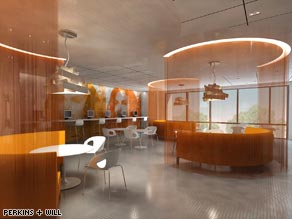
Work stations with a built-in treadmill and portable meeting rooms are just some of the developments that may become commonplace in the offices of the future. Workplace technology has changed dramatically in recent years and the offices we work in are finally set to catch up. The advent of laptops, wi-fi and BlackBerries means that high-tech workers are no longer tethered to their desks, and the office of the future will be designed to let workers roam.


Dutch designer Michiel van der Kley has come up with Globus, a stylish spherical "podule" that looks like a piece of art, but is actually a mobile work station. Open it up, take a seat, switch on your laptop and you're good to go. If you need to see a colleague you can take your laptop with you and talk shop at a ScooterDesk, an ultra-mobile mini work station by Belgian design firm Utilia.

Another Belgian company, Living Tomorrow, predicts that as we become increasingly able to work from home, workplaces will spend more time unoccupied. It says flexibility will be the key to filling unused space, which means that as well as mobile work stations, we'll be seeing mobile meeting rooms.

Perkins + Will.

Offices of the future may include more informal team areas,

like this one designed by Perkins + Will.

Monday, October 20, 2008

Rock, Paper, Scissor...Buckypaper Wins?

Posted on CNN early today:

It's called "buckypaper" and looks a lot like ordinary carbon paper, but don't be fooled by the cute name or flimsy appearance. It could revolutionize the way everything from airplanes to TVs are made.

Buckypaper is 10 times lighter but potentially 500 times stronger than steel when sheets of it are stacked and pressed together to form a composite. Unlike conventional composite materials, though, it conducts electricity like copper or silicon and disperses heat like steel or brass.


"All those things are what a lot of people in nanotechnology have been working toward as sort of Holy Grails," said Wade Adams, a scientist at Rice University.

That idea -- that there is great future promise for buckypaper and other derivatives of the ultra-tiny cylinders known as carbon nanotubes -- has been floated for years now. However, researchers at Florida State University say they have made important progress that may soon turn hype into reality
.

Buckypaper is made from
tube-shaped carbon molecules 50,000 times thinner than a human hair. Due to its unique properties, it is envisioned as a wondrous new material for light, energy-efficient aircraft and automobiles, more powerful computers, improved TV screens and many other products.


Florida State University researcher Ben Wang,
whose computer screen shows a microscopic view of buckypaper.

Friday, October 3, 2008

New Paper that Self Erases???

Recycling's better than sending good paper to the landfill. Even better is not printing in the first place. But there's still a lot of stuff that comes out of printers and some studies show that more than 40% gets discarded on the day it was produced (and a lot of the rest gets discarded not much later, or gets stuffed in a box and is never looked at again).

The researchers at XEROX looked at that problem and came up with a paper that self-erases within 24 hours and can then be re-used. Read on for more details.

Sunday, August 24, 2008

Intel Develops Wireless POWER

Intel on Thursday showed off a wireless electric power system that analysts say could revolutionize modern life by freeing devices from transformers and wall outlets.

Intel chief technology officer Justin Rattner demonstrated a Wireless Energy Resonant Link as he spoke at the California firm's annual developers forum in San Francisco. Electricity was sent wirelessly to a lamp on stage, lighting a 60 watt bulb that uses more power than a typical laptop computer. Most importantly, the electricity was transmitted without zapping anything or anyone that got between the sending and receiving units.

"The trick with wireless power is not can you do it; it's can you do it safely and efficiently," Intel researcher Josh Smith said in an online video explaining the breakthrough.


read more | digg story

Thursday, August 14, 2008

USB 3.0 ready!

Intel today sent out a press release stating that its “Extensible Host Controller Interface (xHCI) draft specification revision 0.9 in support of the USB 3.0 architecture, also known as SuperSpeed USB” is now available. This move not only clears some confusion over claims that Intel may be withholding USB 3.0 specifications, but also indicates that we should be able to see first USB 3.0 demonstrations at next week’s IDF in San Francisco.

When maxed out USB 3.0, will offer ten times the bandwidth of USB 2.0 – 4.8 Gb/s, which translates into a massive bandwidth of 600 MB/s.

read more | digg story

Monday, June 2, 2008

Windows Touch Screen Operating System

CNN's Technology page has released an article mentioning a sneak peek at Microsoft's latest operating system and a special feature planned to be included.

“Microsoft Corp. said Tuesday that its next operating system will be made for touch-screen applications, an alternative to the computer mouse, and its top executives reaffirmed interest in joining forces with Yahoo Inc. Microsoft Chief Executive Officer Steve Ballmer unveiled the iPhone-like touch-screen feature at The Wall Street Journal's "D: All Things Digital" conference, calling it "just the smallest snippet" of the Windows 7 operating system slated for release in late 2009. A Microsoft employee showed possible applications like enlarging and shrinking photos and navigating a map of San Diego by stroking the screen. Microsoft Chairman Bill Gates framed the new feature as an evolution away from the mouse. "Today almost all the interaction is keyboard-mouse," Gates said. "Over years to come, the role of speech, vision, ink - all of those - will be huge.”

To read more of this article, please click here.

Monday, April 28, 2008

The Future of the Wireless Industry

With so many new devices and applications being constantly designed and developed, there is so much potential for future services. Products using wireless service get faster and more efficient every day. Many people rely on wireless services and devices for their everyday needs, such as directions, weather updates, downloading music, and local news, etc. The demand for faster and stronger signals continuously increases. Forecasting new products and services relying wireless technology consists of endless possibilities. Industry experts have proclaimed that the wireless industry will revolutionize our lives, if it hasn’t already done so.

“There's grand talk throughout the tech world about a wave of new networks and wireless innovation that will provide better Internet access, deliver streaming video and foster an array of consumer-friendly features. Although it's too early to be sure which companies or networks will be most successful, the optimists dominate the skeptics…

'As far as identifying what the next wave of applications is going to be, no one really knows,’ said Frank Dickson, chief research officer for MultiMedia Intelligence, a business consulting firm in Scottsdale, Ariz.”

To continue to read more of this article, please click here.

Thursday, April 17, 2008

Upcoming Trend of Video Conferencing

An upcoming trend in business, medical, legal, and educational environments is the avid use of video conferencing. Video conferencing provides a way for people at multiple locations to interact via two-way video and audio transmissions simultaneously. This technology is becoming a popular means of communications between different parties at different locations. In addition to the audio and visual components of videoconferencing, the parties can share documents, charts, and other presentations during the conference. For the participants in the conference, videoconferencing is as simple as viewing a television screen. The use of advanced webcams, televisions, microphones, speakers and a digital telephone network or Internet makes the meeting flow as if the participants were in the same room. For meetings that require attendance by more than two locations, video conferences use a multipoint control unit. The multipoint control unit acts as a bridge or central point for all locations to connect with, similar to an audio only conference call.

As opposed to the planned face to face meeting, video conferencing offers clients another possible alternative. The use of video conferencing is highly suitable for when a live conversation is needed, visual information is an important component of the conversation, the parties of the conversation can't physically come to the same location or the expense or time of travel is a consideration. As travel expenses, time and monetary costs, continue to rise, the solution of video conferencing provides a cheap solution. Local professional video conferencing sites can be found within a reasonable distance for all end users. Additionally, for the last minute or short notice meetings the use of video conferencing has become a highly popular means of communications.

Video conferencing has had a profound impact on the business, medical, legal, and educational atmosphere. Below are just a few way in which video conferencing has improved the following areas:

Impact on Business Environments
  • Lower costs for meetings in distant locations.
  • Attending meetings on short notice.
  • Sharing of presentations and information first hand.
  • Reduces travel time.
  • Faster decision making.
  • Improves customer and employee relations.
Impact on Medical Environments
  • Diagnosis, consulting, transmission of medical images in real time.
  • More efficient use of health care money.
  • Special peripherals such as microscopes fitted with digital cameras, video endoscopes, medical ultrasound imaging devices, otoscopes, etc., can be viewed with video conference equipment.
  • Deaf and hard of hearing individuals can communicate via sign language.
Impact on Education
  • Two-way distance learning.
  • Teaching brought into remote locations.
  • Guest lecturers brought into classes.
  • Virtual field trips, students can visit another part of the world.
  • Small schools can use pool resources and teach courses (such as foreign languages) which could not otherwise be offered.
  • Regular collaboration amongst colleagues at other institutions.
Impact on Legal Environments
  • Receive testimony from individuals not able to attend a physical location.
  • Flexible scheduling of depositions.
  • Convenient scheduling of meetings or witness interviews.
  • Collaborate with clients or co-counsel.
A well designed system requires a specially designed room and can cost thousands of dollars to outfit the room with proper input and output devices, furniture and other integration equipment. Furthermore, many companies/end users do not have the technical experience to properly run and maintain their own video conference equipment. As an alternative, many companies/end users contract this service through video conferencing equipped meeting rooms in cities around the world. Customers simply reserve the rooms and show up for the meeting. Everything else is arranged and support is readily available if anything should go wrong. To read more on this topic or to schedule a video conference, please click here.

Friday, March 28, 2008

Webmail Service Tips

From time to time, I come across some helpful tips on a variety of topics, this one happens to be related to webmail services. The other day I ended up at a link from www.makeuseof.com explaining some very interesting features for Gmail accounts. Today, most people need to access there emails on the go from any location. Gmail is a great free web based email service that seems to have continuous upgrades and many new extensions to help make Gmail even easier to use. In this post, there are links to two websites. Both sites give links and explanations of over 80 tips and extensions. They include shortcut lists, scripts, additional web applications, and a series of how to’s. However, besides the over 80 tips, I found the article on how to use just one email address for multiple purposes, one for family, one for friends, one for those websites that require and email address to sign and how to separate them in your inbox the most interesting.

Over 80 Gmail Tips

One Surprising Gmail Tip

Tuesday, February 12, 2008

Our First Post!

Welcome to MedCom Professional Services, Inc. Blog. We hope that you frequently visit this blog to stay up to date on current events with our company, staff, technology and customer service. We encourage you to post comments and feedback. This is an opportunity for you to keep in touch with us, share your thoughts and experiences, and maybe even learn something new every now and then.

About MedCom.
MedCom, located in Levittown, PA, began its 24/7 answering service with a handful of clients in 1987, many of which are still with us today. MedCom has grown into a nationwide answering service, handling clie
nts in the medical, professional and commercial industries. From its inception, MedCom's commitment has been to provide the highest quality services to our client base. We have built our reputation and our business by growing in a controlled and steady manner. We offer our clients continued improvements in systems and technology and we maintain the highest standards of professional excellence. MedCom is fully committed to our staff of 30 employees. In an industry that traditionally compensates its staff with low wages, offers no benefits and experiences 50% employee turnover, MedCom stands out in employee compensation and loyalty. We offer our CSRs a living wage, comprehensive health benefits and profit sharing. Additionally, we provide significant bonus incentives to staff and managers alike. Motivated employees who have a personal stake and who care about their job will always outperform the competition. As a result of MedCom's management team and loyal staff's effort to provide the highest quality service, our company has been awarded the ATSI Award of Excellence for 10 consecutive years. In 2007, MedCom received the award for the top score as the nation's best answering service.


Thank you for taking the time to visit our blog. We look forward to this new way to communicate to our clients, staff and all other visitors to this forum. Again, we encourage everyone to respond with your comments and experiences. For more information about MedCom, please visit our website at www.medcom.us.